Three semiconductor monopolies trade inside Japanese conglomerates the market files under glass, seasonings, and eyeglasses. Hoya supplies roughly 60% of EUV mask blanks, Ajinomoto at least 85% of ABF build-up film, and AGC holds the other quarter of the blank duopoly. Each monopoly is a revenue minority, so no screen surfaces it.
Three of the tightest monopolies in the semiconductor supply chain trade inside Japanese companies the market has filed under glass, food, and diversified chemicals. The pattern is the same in each case. The monopoly is a minor share of the parent's revenue, so the market prices the parent and applies a discount as if the moat did not exist. That mispricing is measurable, and this post walks through the numbers.
Hoya supplies roughly 60% of the mask blanks behind every EUV exposure on Earth and runs a 79.0% gross margin, yet trades about 25% below its sector's median multiple. Ajinomoto, best known for seasonings, controls at least 85% of the ABF build-up film inside virtually every AI accelerator substrate. AGC, the #2 blank supplier, trades at 15.96× with a 3.27% yield. All figures are from the Stocks & Signals Equipment & Materials report, July 2026 issue. Screens for undervalued semiconductor stocks never surface any of the three, because the discounts are filed under eyeglasses, seasonings, and glass.
Why does the market price these monopolies as conglomerates?
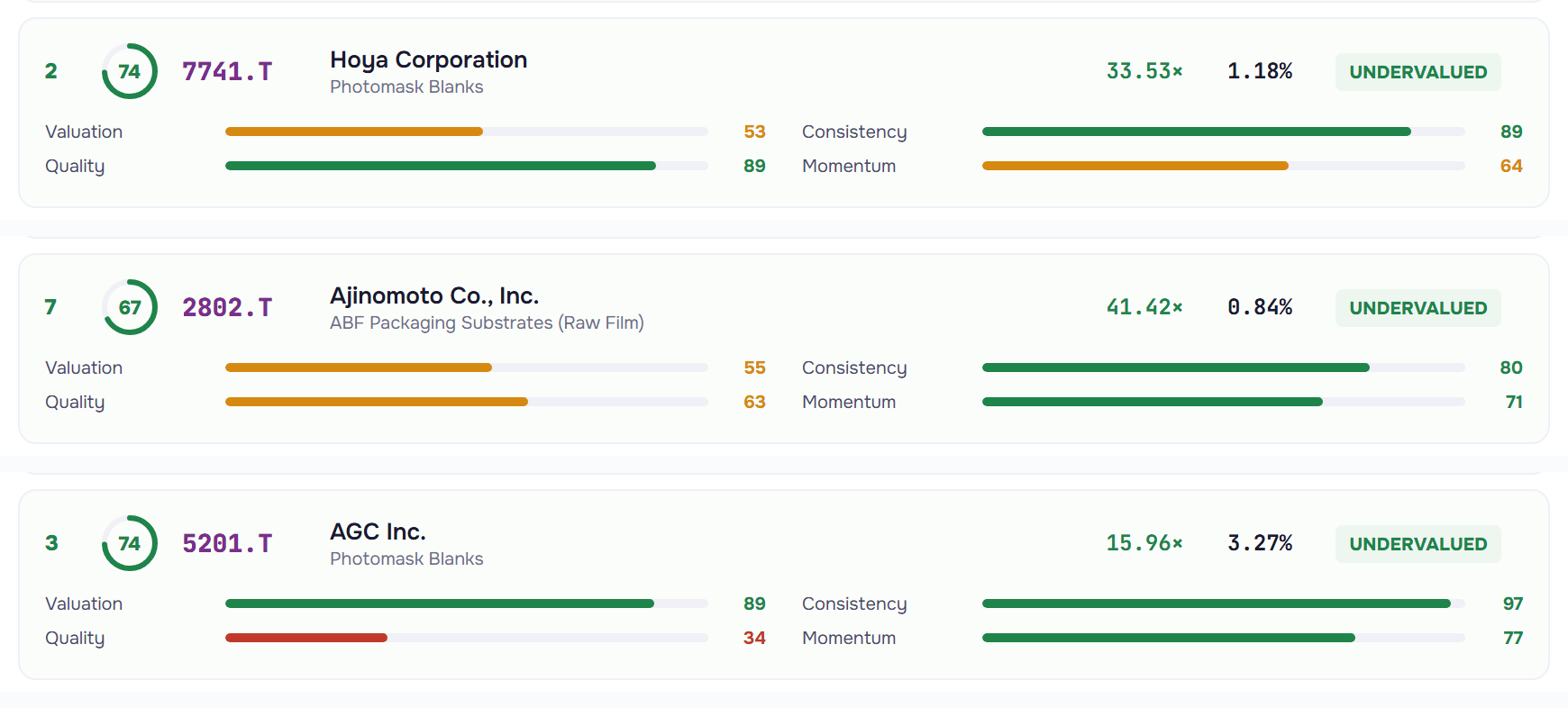
Because it prices what it can see, and these franchises are buried. Each monopoly is a revenue minority inside a conglomerate, so no screen surfaces it and no headline multiple reflects it. Our scoring makes the bias visible. Hoya's Valuation component is 53, Ajinomoto's 55, AGC's 89, while pure-play equipment names in the same coverage carry premium multiples on comparable or weaker concentration. The market rewards the well-understood, English-language, pure-play story and discounts the segment-buried materials story even when the buried segment controls the tighter monopoly. This is the bottleneck controller pattern with an extra layer of camouflage on top.
The diversification is usually read as dilution. In cash flow terms it works the other way, stabilizing earnings through the semiconductor cycle. Both can be true at once — the wrapper steadies the earnings and suppresses the multiple — and that tension is where this whole thesis lives. The moat is intact. Only the label is wrong.
Hoya, the eyeglass company with the best economics in the coverage
Hoya's consolidated business is optical glass, hard-disk substrates, and medical endoscopes. The electronics business that houses its mask blanks is about 31% of revenue, and the blanks themselves are a slice of that. The slice is one of the chain's two tightest materials chokepoints. Together with AGC, Hoya forms a roughly 85% duopoly in photomask blanks, and it holds ~60% of the EUV segment specifically, where a single blank carries 40+ alternating molybdenum and silicon layers, each a few nanometers thick, at near-zero defect density across a 152mm reticle. That process control took decades to accumulate, and nobody else has it at scale.
The scores tell the mispricing story compactly. Value Edge 74, ranked #2 of all 89 companies in the issue. Consistency 89 and Quality 89, both at the top of the coverage, against a Valuation component of just 53. Translated, the best operating business in the coverage universe trades at 33.53× versus a 45× sector median (the median of the sector's profitable names), with revenue still compounding at 9.4%. The market is still paying for Japanese optics. It is getting a lithography chokepoint.
Ajinomoto, the MSG company inside every AI accelerator
Ajinomoto Build-up Film is the insulating dielectric inside virtually every advanced IC substrate for high-performance computing. Every AI accelerator, server CPU, and interposer routes through it, and the substrate fabricators downstream, Ibiden, Unimicron, and Samsung Electro-Mechanics, all take ABF as their fundamental input. Those three trade at 88.97×, 123.94×, and 145.66× in the same coverage, against 41.42× for the chemistry every one of them depends on, one layer upstream at monopoly concentration.
That comparison reads both ways, and it is worth saying so: the fabricators may simply be expensive rather than Ajinomoto cheap. What the spread does establish is that the market pays up for AI-packaging exposure at the fabrication layer while pricing the chemistry those fabricators cannot substitute as a food company. The moat is chemistry co-optimized with them over two decades, from dielectric loss tangent to thermal expansion matching. Ajinomoto is the chemical IP itself, not a bet on any single fabricator's fortunes.
The film sits inside a functional-materials business that booked ¥100.7 billion of the company's ¥1,583.7 billion revenue last fiscal year by its own segment disclosure, roughly 6%, and that slice carries a business-profit margin above 50%. The rest is seasonings, frozen food, and amino acids. Value Edge 67, with a Momentum component of 71 suggesting the sum-of-parts recognition has already started moving through the numbers. ABF is also the highest-scoring segment on our entire equipment and materials map, at 82. The sum-of-parts case now has an activist attached, too. Palliser Capital's March 2026 value-enhancement plan for Ajinomoto puts the ABF share near 95%, which makes our ~85% the conservative end of the range.
Temper that appropriately. Most activist campaigns in Japan do not achieve their headline objective, and the ones that do take years, so Palliser is best read as corroboration of the market-share estimate first and as a catalyst second.
AGC, the deep-value entry to the same duopoly
AGC holds the other ~25% of the blank market and trades like a boring industrial, at 15.96× with a 3.27% dividend yield. Its component scores are the most lopsided in this group and worth reading honestly. Valuation 89 and Consistency 97, both near the top of the coverage, against a Quality score of 34. That 34 is the counterweight, a low-margin diversified glass and chemicals business in which the blank franchise is deeply buried. The re-rating case requires the market to start pricing the #2 EUV-blank position above zero. The risk is that the conglomerate structure suppresses the multiple indefinitely without restructuring.
Same chokepoint as Hoya, opposite temperament. One is the quality expression of the duopoly, the other the deep-value expression, and the spread between their multiples, 33.53× against 15.96×, is itself a measure of how differently the market treats the same moat depending on the wrapper.
The three side by side
| Hoya | Ajinomoto | AGC | |
|---|---|---|---|
| Known for | Eyeglass and optical glass | Seasonings, MSG | Glass, chemicals |
| The buried monopoly | ~60% of EUV photomask blanks | ~85% of ABF build-up film | ~25% of photomask blanks |
| Share of parent revenue | ~31% (electronics; blanks a slice of that) | ~6% (functional materials) | Minor share |
| P/E (July 2026 issue) | 33.53× | 41.42× | 15.96× |
| Dividend yield | 1.18% | 0.84% | 3.27% |
| Value Edge | 74 | 67 | 74 |
| Standout component | Quality 89, Consistency 89 | Consistency 80, Momentum 71 | Valuation 89, Consistency 97 |
| Honest weakness | Valuation only mid-pack | Multiple already elevated | Quality 34 |
| Sector median P/E | 45× | 45× | 45× |
All three sit in the sweet-spot quadrant of our valuation heatmap, where bottleneck power and Value Edge overlap. Getting there through a food company and two glass companies is the whole point.
Three cases, one structural feature
This is not a coincidence that happened three times. Japan industrialized specialty chemistry and precision materials inside large diversified groups, so the country's semiconductor chokepoints tend to live as divisions rather than pure plays. Screens cannot see them, because every consolidated ratio blends the monopoly with the seasoning business or the architectural glass, which is why lists of undervalued Japanese stocks almost never include these three names.
Three things keep them invisible. English-language coverage is thinner than the equipment names enjoy, passive flows track the consolidated market cap rather than the franchise inside it, and the usual hunting ground for hidden gem stocks is small caps nobody follows. These are hidden the opposite way: large, liquid, widely held companies whose gem is a rounding error in the consolidated accounts. When we scored all 89 companies in this module, the pattern held tightly enough that it became the issue's lead finding, stated in one line. Japan's bottleneck controllers are priced as the conglomerates that house them, not the monopolies they are.
What did the August earnings do to the thesis?
Graded it, four weeks after the fact. Every score in this post comes from a data snapshot dated July 12, 2026, and all three companies reported between July 31 and August 6, so the quarter functions as an out-of-sample test. Hoya printed revenue up 16.0% and operating profit up 30.0% on July 31, named advanced mask blanks as a key driver, ran a 55.1% operating margin in the segment that houses them, and announced a buyback of up to ¥200 billion. Ajinomoto followed on August 6 with record quarterly results and raised full-year guidance on the strength of the functional-materials business that makes ABF, three weeks after our snapshot printed its Momentum component at 71.
AGC was the stress test. Strong first half on August 4, guidance held flat, shares down roughly 8% in a day. The issue's event calendar had flagged that exact print in advance, watching "glass-segment margins as a barometer of the conglomerate drag," and the drag arrived on schedule. Two theses confirmed, one tripwire fired, and the firing made the deep-value entry cheaper. AGC closed August 7 near 13.6×, below the 15.96× we scored it at.
One caveat belongs here rather than only in the AGC section above, because August is what it looks like in practice. AGC's Quality score of 34 is a real warning, and the weakest business quality of the three by a distance — Hoya scores 89 and Ajinomoto 63 on the same measure. A strong franchise-level quarter that still could not move the parent's guidance is exactly what a low-margin conglomerate wrapped around a good business produces. The cheaper entry and the weaker business are the same fact, not two separate ones, and nothing in the August print changed that.
What could close the gap, and what could keep it open?
Two catalysts are live. Export-control policy has been migrating from tools toward materials since the 2023 to 2024 restrictions on lithography sales, and the 2019 Japan and Korea photoresist episode is the documented precedent that materials can be weaponized. Anything that reminds the market these films and blanks are strategic assets is a re-rating trigger, though the same force becomes a tail risk if controls ever restrict the franchises themselves. Sum-of-parts recognition is the slower catalyst, and Ajinomoto's momentum suggests it is underway. The conglomerates themselves have started foregrounding the buried franchises. AGC's June 2026 semiconductor briefing targets a doubling of semiconductor revenue to ¥200 billion by 2030, and Ajinomoto is absorbing its Fine-Techno film subsidiary into the parent in April 2027, pulling the ABF business closer to the consolidated story the market actually reads.
The honest other side, strongest version first. A conglomerate discount is not automatically an error. A minority shareholder does not own the mask-blank franchise; they own a claim on a parent whose board decides where that franchise's cash goes, and it can go into endoscopes or architectural glass at returns nobody underwrote. If the cash stays captive, the monopoly's economics accrue to the parent rather than to the shareholder, and a discount is the rational price of that arrangement rather than a mistake in it.
What makes this more than hope is that all three companies are now moving the other way. Hoya's ¥200 billion buyback returns cash directly. Palliser is pressing Ajinomoto to surface the ABF value. The Fine-Techno absorption pulls that business into the consolidated story the market actually reads. Those are the mechanisms by which captive cash becomes shareholder cash, and they are the things to watch — more than the multiple itself.
The rest of the other side is shorter. Conglomerate discounts can persist for decades without a restructuring event. AGC's Quality 34 is real. Ajinomoto's multiple already carries some recognition. All three report in yen, so a dollar-based investor is carrying a currency position alongside the equity one. And every company here is levered to the same AI capital cycle now lifting the entire equipment and materials complex, in which wafer-fab equipment spending is forecast at $143.9 billion for 2026, up 23% year over year (SEMI mid-year forecast, July 2026). If that cycle turns, these monopolies fall with the visible ones.
What would change our mind is equally specific. A qualified new blank supplier taking share from the Hoya and AGC duopoly, glass-core substrates reaching volume production ahead of the three-to-five-year window our report assigns them, or a wafer-fab equipment downturn would each break a leg of this thesis, and the quarterly refresh would say so.
What the full report adds
The issue behind this post scores all 89 equipment and materials companies, ranks them, sets buy and sell zones on the highest-conviction names, and stress-tests the theses against disruption scenarios. One detail for the road. The #1-ranked company in the issue is not Japanese and not famous. It is an American industrial that almost nobody connects to semiconductors, and it outscored everything in this post. Its name is in the ranking.
Common questions
Are Hoya, AGC, and Ajinomoto undervalued semiconductor stocks?
By our scoring, yes. All three rate Undervalued on Value Edge as of the July 2026 issue, Hoya and AGC at 74 and Ajinomoto at 67, meaning each discount survived checks on quality, consistency, and momentum against industry peers. None of them surface on conventional screens, because the semiconductor franchise in each case is a minority segment inside a conglomerate classified as optics, glass, or food.
Why is Hoya considered undervalued?
Because it combines roughly 60% of the EUV photomask blank market with the highest gross margin and Quality score in our coverage while trading at 33.53 times earnings, about 25% below the sector median. The discount reflects its classification as a Japanese optics conglomerate rather than any weakness in the semiconductor franchise.
What is ABF and why does Ajinomoto control it?
ABF, Ajinomoto Build-up Film, is the insulating dielectric layer inside advanced IC substrates used in AI accelerators, server CPUs, and interposers. Ajinomoto developed it from its amino acid chemistry and holds at least 85% of the market by our conservative estimate, with recent industry and activist estimates above 95%. Two decades of joint development with substrate fabricators makes the specification extremely hard to displace.
What makes AGC different from Hoya as an investment?
They occupy the same photomask blank duopoly with opposite profiles. Hoya is the quality expression, with top-of-coverage margins and consistency at a mid-pack valuation. AGC is the deep-value expression, at 15.96 times earnings with a 3.27% yield and near-perfect consistency, but a Quality score of 34 that reflects the low-margin conglomerate around the franchise.
What are the risks of investing in Japanese conglomerate monopolies?
Four main ones. Conglomerate discounts can persist indefinitely without restructuring or shareholder pressure, and they are not always wrong: the parent's board decides where the franchise's cash goes, so the monopoly's economics may never reach the shareholder. The franchise also never dominates consolidated results, so the thesis needs the market to price a segment rather than a company. All three report in yen, so a dollar-based investor carries a currency position alongside the equity one. And every position is levered to the AI capital-spending cycle, so a downturn in fab investment hits them regardless of moat quality.
References
Score components, multiples, market shares, and the 45× sector median are from our own July 2026 issue, data snapshot July 12, 2026. Every external claim traces to a primary source below.
- AGC Inc. (2026). "Semiconductor Business Briefing," June 2, 2026. Semiconductor revenue target of ¥200 billion by 2030.
- AGC Inc. (2026). Investor relations, consolidated results for the six months ended June 30, 2026.
- Ajinomoto Co., Inc. (2026). "Revision of Full-Year Consolidated Financial Forecasts," August 6, 2026.
- Ajinomoto Co., Inc. (2026). Notice on the absorption-type merger of Ajinomoto Fine-Techno, August 6, 2026.
- Ajinomoto Co., Inc. (2026). Segment disclosures, fiscal year ended March 31, 2026, investor relations library.
- Hoya Corporation (2026). Financial results, first quarter of the fiscal year ending March 2027, July 31, 2026.
- Palliser Capital (2026). "Ajinomoto Value Enhancement Plan," March 2026.
- SEMI (2026). Mid-year total semiconductor equipment forecast, July 2026. Wafer-fab equipment forecast of $143.9 billion for 2026.
- Stocks & Signals (2026). Semiconductor Equipment & Materials, July 2026 issue. 89 companies scored, data snapshot July 12, 2026.
Written by the Stocks & Signals research team: 25+ years of experience across equity markets, algorithmic trading, and supply chain analysis.
The full ranking and scenarios are subscriber content. Start with the free preview issue to see the format on real data.