Bottleneck investing is a strategy that targets companies holding monopoly or near-monopoly positions in critical supply chain segments, where customers have no practical substitute. We call these companies bottleneck controllers. They sit several layers upstream from the products everyone knows, in materials, equipment, and process steps most fundamental analysis never reaches.
The market tends to price the bottleneck power it can see and miss the bottleneck power it cannot, so a visible tool monopoly can trade at a full premium while an equally irreplaceable materials monopoly buried inside a conglomerate trades below its sector's median. Finding these positions, and knowing which price is a discount and which is deserved, is the core of supply chain investing.
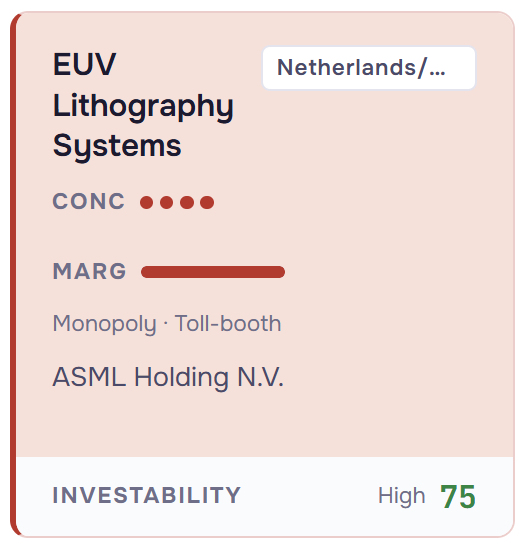
ASML has built every production EUV lithography machine in existence. Five Japanese companies supply roughly 90% of the world's semiconductor photoresist. Hoya alone produces about 60% of the EUV mask blanks used to print every advanced chip design (Stocks & Signals Equipment & Materials report, Q2 2026).
Most investors never see these companies because of an assumption so basic it goes unexamined. Supply is deep, a second source always exists somewhere, and if one supplier fails another steps in. For most of the economy that holds. At the bottom of advanced manufacturing it does not, and the places where it breaks down are where the most defensible businesses in the world quietly operate.
Why do supply chains create monopolies?
Three forces push critical supply chain segments toward single suppliers, and none of them is easy to reverse. Capital intensity means a competing plant costs billions and takes years before its first sellable unit. Accumulated process knowledge compounds, so a challenger is not catching up to a product but to decades of yield learning. And qualification barriers mean customers must re-certify any new supplier through cycles that can take years, during which production risk sits entirely on the customer.
Macro research reached the same conclusion from the other direction. The Bank for International Settlements described how low short-run supply elasticity turns concentrated industrial inputs into economy-wide constraints (BIS Bulletin No 48, "Bottlenecks: causes and macroeconomic implications," 2021). What a central bank calls a fragility, an investor can read as a moat.
Temporary shortages are not structural monopolies
This distinction matters more than any other idea in this post. A temporary bottleneck attracts capital, gets solved, and collapses. A structural bottleneck persists for decades because the barrier is not money but knowledge, physics, or qualification lock-in. One is a trade. The other is an investment.
| Temporary bottleneck | Structural bottleneck | |
|---|---|---|
| Cause | Demand spike outruns capacity | Knowledge, physics, or qualification barriers |
| Fix | Capital expenditure | Decades of accumulated capability |
| Example | CoWoS advanced packaging, ramping from roughly 35K wafers per month in late 2024 toward a planned 120K+ by the end of 2026 (TrendForce) | EUV lithography, where ASML has faced no competitor in over 30 years of development |
| Pricing power | Spikes, then mean-reverts | Persists through cycles |
| For investors | A trade with an expiry date | A compounding position |
When commentators dismiss bottleneck investing as chasing shortages, they are describing the left column. Our work is exclusively about the right one.
Aren't these just cyclical hardware stocks?
No, and the recurring economics prove it. The standard rotation narrative treats hardware as the cyclical trade and software as the durable one. That framing breaks at the bottleneck layer. ASML's installed base generated about €8.2B in annual service revenue in 2025, up 26% year on year, and roughly 90% of the systems it has sold over three decades are still running in fabs today (ASML annual report). Machines cycle. Service contracts on irreplaceable machines do not.
Shin-Etsu offers the same lesson in materials. Wafer prices move with the cycle, but a fab that has qualified Shin-Etsu silicon cannot switch suppliers without 12 to 24 months of requalification and real yield risk. The revenue line looks cyclical. The customer relationship behaves like a subscription with a multi-year cancellation notice.
The stickiest switching costs are not in software
Enterprise software gets credit for high switching costs because migrating data and retraining teams is painful. Bottleneck switching costs are a different category of pain. Replacing a qualified materials supplier means re-running qualification on live production lines, where a failed batch destroys product worth more than the savings from switching. That is why supplier relationships in semiconductor materials routinely outlast the careers of the engineers who set them up.
How deep does the supply chain go?
Deeper than almost anyone models. NVIDIA depends on TSMC for manufacturing. TSMC depends on Shin-Etsu and SUMCO for silicon wafers, the two Japanese producers that together hold roughly 53% of the global wafer market, a de facto duopoly over the material every chip starts as. And wafer production itself depends on high-purity quartz crucibles, consumed in the crystal-growing process, made from quartz that comes overwhelmingly from two mines around Spruce Pine, North Carolina, a town of about 2,200 people.
The crucibles dissolve into the melt at around 1,420°C and are discarded after a handful of ingot pulls, each one a batch of wafers. Both mine operators are private, and Sibelco alone is investing roughly $700M across two expansions through 2027 (company announcements), with The Quartz Corp expanding in parallel. When Hurricane Helene shut the mines for roughly two weeks in September 2024, it exposed a single-source risk sitting beneath the entire semiconductor industry that almost no equity model priced. Fundamental analysis of NVIDIA will never surface Spruce Pine. Mapping the value chain does.
Why does the market misprice bottleneck controllers?
Because it files them under the wrong label. The market prices many of these companies as cyclical chemicals, boring industrials, or diversified Japanese conglomerates, then fixates on a single year of earnings. A company with a durable monopoly, multi-year switching costs, and decades of process knowledge gets valued like a commodity producer because the screen reads one cyclical year instead of the position.
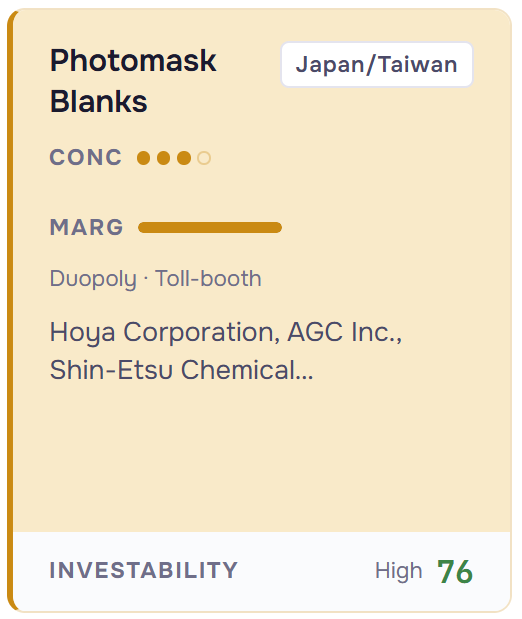
Hoya is the cleanest current example. It holds roughly 60% of the EUV mask-blank market at a gross margin near 79%, among the highest of any operating business we cover. Yet it trades around 33 times earnings, a quarter below the sector median, because the monopoly is buried inside a company better known for eyeglass lenses (Stocks & Signals coverage). Its true peers in irreplaceability, the lithography and inspection monopolies like ASML and KLA, trade above 60 times. Hoya does the same job for the supply chain and trades at half their multiple. The misclassification is the opportunity.
The market pays for the moats it can see
The split runs through the whole coverage. The market pays full price for the monopolies it recognizes, ASML near 61 times and Teradyne near 66, where owning the position means paying for a moat everyone can see. The materials monopolies of equivalent irreplaceability trade the other way. AGC holds the other half of the EUV mask-blank duopoly and trades at roughly 16 times, because its franchise sits inside a glass and chemicals parent. Same bottleneck power, opposite multiples, and the gap between them is where the mispricing lives.
How do you actually find these companies?
Map first, screen second. When we mapped 89 equipment and materials companies for our Q2 2026 issue, the process surfaced nine chokepoints, and only some of them were investable at current prices. Concentration alone is not enough. We look for three things together, a dominant share of a segment customers cannot route around, a gross margin that proves pricing power rather than just share, and a valuation that has not already paid for the moat.
That last filter matters because some of the strongest monopolies are openly expensive. Owning the moat is not the goal. Owning the moat at a price that undercounts it is. We publish the scoring methodology behind this in full.
Examples of bottleneck controllers in 2026
ASML is the sole producer of EUV lithography systems, without which no chip below 7nm is manufactured at scale. TSMC fabricates 85 to 90% of the world's sub-7nm logic capacity (Stocks & Signals Compute & Memory report, Q2 2026). Hoya supplies about 60% of the photomask blanks used in EUV lithography. Ajinomoto, a food company, controls roughly 85% of ABF build-up film, a substrate layer inside virtually every AI accelerator (Stocks & Signals Equipment & Materials report, Q2 2026). Carl Zeiss SMT is the only source of EUV optics, produced at a single site in Oberkochen, Germany.
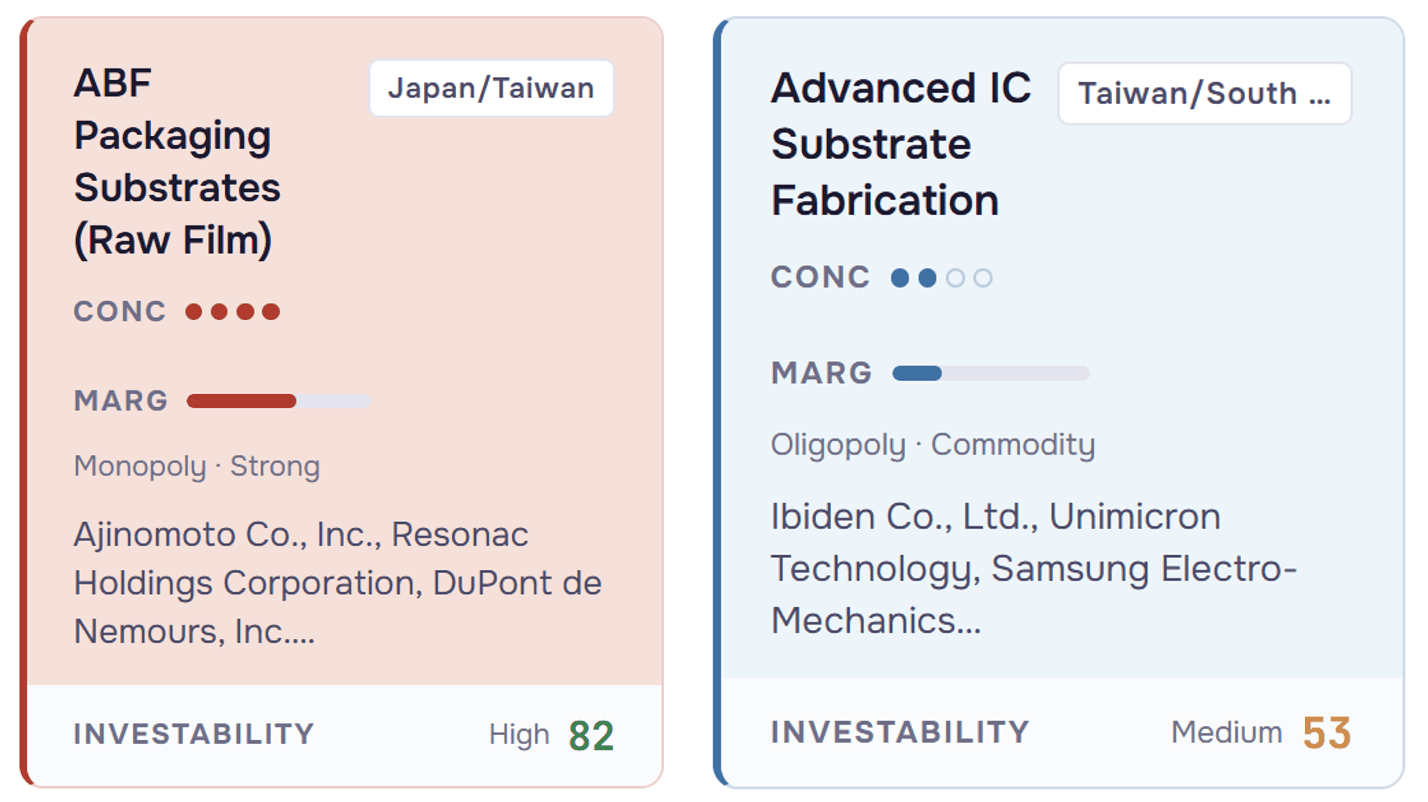
Some of these are attractively priced today. Some are excellent businesses at dangerous prices. Which is which changes quarter to quarter. The free preview issue shows how we score the difference on a full industry, and the current verdicts live in the paid issues.
Common questions
Is NVIDIA a bottleneck controller?
No. NVIDIA is a customer of bottleneck controllers. Its designs depend on TSMC's fabrication, ASML's lithography, and materials monopolies several layers down. NVIDIA holds a dominant market position in AI accelerators, but its suppliers hold positions with fewer substitutes and, often, lower valuations.
Is a bottleneck controller the same thing as a wide-moat stock?
The concepts overlap but are not identical. Moat analysis usually starts from brands, network effects, and cost advantages visible at the product level. Bottleneck control is a structural position inside a supply chain, frequently invisible at the product level, and often held by companies too small or too obscure for mainstream moat coverage.
Are bottleneck controllers value stocks or growth stocks?
They cross both labels, which is part of why screens miss them. Many trade at value multiples because the market reads them as cyclical, while their earnings compound through positions that behave like infrastructure. The useful question is not the style box but whether the current price pays for the monopoly.
Is bottleneck investing the same as value investing?
No, though they overlap. Value investing screens for statistical cheapness across the whole market. Bottleneck investing starts from supply chain structure, finds the positions customers cannot route around, and only then asks whether the price undercounts them. Many bottleneck controllers happen to screen as value stocks because the market misclassifies them, but the moat comes first in the analysis, not the multiple.
How many bottleneck controllers exist?
Our semiconductor coverage alone, 143 companies across two modules, identifies nine critical chokepoints controlled by a smaller set of companies. Extend the method across life sciences, energy infrastructure, defense, and industrial supply chains, as our weekly coverage does, and the global set is plausibly in the low hundreds. It is a small universe, which is the point.
Written by the Stocks & Signals research team: 25+ years of experience across equity markets, algorithmic trading, and supply chain analysis.
Want to see the method applied? Get the free preview issue, with the full value chain map and sample chokepoint analyses ungated.